Your mother gives you a kilogram of aluminum and a kilogram of lead. Both objects are solid, rectangular blocks.
Which is more massive on the surface of the Earth?
Which is more massive on the surface of the Moon?
Which is heavier on the surface of the Earth?
Which is heavier on the surface of the Moon?
Special notes:
The phrase "more massive" should be read literally as "has more mass" not "fills more space".
The phrase "heavier" should be read as "is pulled down more strongly by gravity" not "is more dense".
A variation on this practice problem appears later in the section on buoyancy.
A acrylic cube has a mass of 142.5 g and a width of 4.9 cm. Determine its density in kg/m3.
It has been known for several thousand years that the Earth is spherical (by educated people, at least). Sometime in the 2nd century BCE the size of the Earth was determined (rearth = 6371 km). By the 19th century its mass was known (mearth = 5.97 × 1024 kg). And in the early 20th century the structure of the Earth was deduced. The Earth has three main layers: crust, mantle, and core. The crust of the is the lightest and thinnest and, like the shell of an egg, contributes little to its overall mass. The mantle is a bit more dense, substantially thicker, and contains most of the Earth's mass. The core is the densest layer (but not the most massive) and is divided into a liquid outer core and a solid inner core. The relevant data for the interior of the Earth are summarized below.
The structure of the Earth
layer
depth range (km)
mean density (kg/m3)
consistency
crust
00–20
2700
solid
mantle
0020–2890
4500
plastic
outer core
2890–5160
?
liquid
inner core
5160–6370
?
solid
Determine…
the average density of the entire Earth
the percent of the Earth's mass located in the mantle, and
the average density of the core.
Write something completely different.
conceptual
Mayonnaise is essentially a mixture of vegetable oil and water with a bit of egg yolk added as an emulsifier (a substance that keeps the oil and water from separating). Traditional mayonnaise has a density of about 910 kg/m3 while reduced fat, low calorie, or "light" mayonnaise has a density of about 1,000 kg/m3. Why is "light" (low calorie) mayonnaise "heavier" (more dense) than traditional mayonnaise?
Why does "heavy cream" have a lower density than "light cream"? Explain this apparent contradiction.
numerical
Find the mass of the air contained in a room that is 16.40 m long by 4.5 m wide by 3.26 m high.
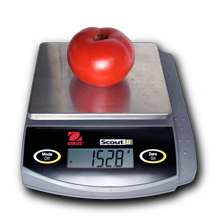
How much larger is a 152.8 g tomato at room temperature (20 °C) than when it is in a really cold refrigerator (4 °C)? Assume tomatoes are spheres of pure water. Give your answer in cubic centimeters or milliliters, your choice. (That's a joke by the way. Milliliters and cubic centimeters are identical. Also, I realize that tomatoes are not actually spheres of pure water. Physicists approach problems by approximation. Let's not make this problem any more difficult than it needs to be. A tomato is a sphere of pure water for now. Also, I realize that tomatoes lose flavor when chilled. Avoid putting fresh tomatoes in the refrigerator.)
The Castello Cube is a modernist sculpture designed by German artist Niclas Castello that is essentially a box made of pure gold. It was first publicly displayed in New York's Central Park where it sat in melting snow for 12 hours on 2 February 2022.
Compute the density of gold using only the values in the table above.
What would be the length of a side of the Castello Cube if it was crushed into a cube that was no longer hollow?
What would be the mass of the Castello Cube if it was entirely filled with gold?
Standard objects have been used for weighing purposes since commerce was invented. Put a commodity you're selling like corn, rice, or wheat on one side of a pan balance. Add some standard masses to the other pan until the beam of the balance is level. You now have as much mass of the commodity as the mass of the standard objects. Such objects are essential to fair trade — and science. For 130 years there was one standard mass that reigned supreme. The International Prototype of the Kilogram (IPK), or Le Grand K as it was sometimes called, was constructed in 1879 to replace the many standard kilograms that were floating around France in the mid 19th century. These were originally built to agree with the first definition of the kilogram — the mass of a cubic decimeter (a liter) of pure water at the temperature of melting ice. Le Grand K ruled the world until 2019 when the kilogram was redefined in terms of universal constants. It now rests comfortably in the offices of le Bureau International des Poids et Mesures (the International Bureau of Weights and Measures) in the suburbs of Paris.
Properties of the International Prototype of the Kilogram (IPK)
*per cent by mass
shape
height
diameter
mass
composition*
right circular cylinder
39 mm, approximately
39 mm, approximately
1 kg, exactly
90% platinum 10% iridium
Given the information in the table above, determine the following to 5 significant digits…
the volume of the IPK in…
cubic millimeters
cubic centimeters (milliliters)
cubic decimeters (liters)
cubic meters
the density of the IPK in kg/m3
Density of selected materials
material
density (kg/m3)
iridium
22,400
platinum
21,450
Use the additional information in the table above to determine the following to 5 significant digits…
the volume of the IPK that is platinum
the volume of the IPK that is iridium
the volume of the IPK as a whole given the results of your two previous calculations
the height and diameter of the IPK in millimeters using the results of your previous calculation and assuming that both measurements were meant to be the same, which was the intention of the designers
statistical
Determine the mean density of the Earth, moon, and sun. (That's the mean value for each object individually, not the mean of all three objects collectively.) Compile your results in a table like the one below.
object
mass
radius
density (kg/m3)
Earth
Moon
Sun
Determine the density of the following astronomical objects arranged in order of increasing mass. (Pay attention to the units.)
object
mass
radius
density (kg/m3)
the Sun
1.99 × 1030 kg
696,000 km
white dwarf star
0.5 to 1.4 solar masses
5,000 km
neutron star
1.4 to 3 solar masses
10 km
stellar black hole
more than 3 solar masses
2Gm/c2 (event horizon)
supermassive black hole
>106 solar masses
2Gm/c2 (event horizon)
the known universe
1053 kg
13.8 × 10⁹ light years
It is usually said that the moon has no atmosphere, but this is not quite true. The moon's atmosphere is nowhere near as dense as the Earth's or even that of Mars (which is pretty thin) but it is more dense than the "vacuum" of interplanetary space. The table below gives the partial densities of the constituent gases in the moon's atmosphere in particles per cubic centimeter.