This is an experiment that you can try at home if you have an old TV or computer monitor. Take a strong magnet and hold it up to a CRT display.
Why does the image become distorted?
Why is the image covered with colored bands of red, green, and blue?
Why does the color stay screwed up after the magnet is removed?
Why does the color return to normal after the television has been turned off and back on?
Why doesn't this effect occur with LED, LCD, and plasma displays?
Three successive electromagnetic experiments (a., b., and c.) are performed on an electron beam as shown in the diagram below. (Ignore the effects of gravity in this problem.)
The beam enters region a. with negligible initial velocity and is accelerated across a potential difference of 10,000 V in the space of 10 cm. Determine…
the magnitude of the electric field in this region
the net force on the electrons in this region
the final speed of the electrons when they exit this region
The beam then passes into region b. where there are both electric and magnetic fields. The electric field strength in region b. has the same magnitude as region a. but points downward. The magnetic field in region b. points inward and is adjusted so that the magnetic and electric forces on the electron beam cancel out. Determine…
the magnitude of the magnetic field in this region
The beam finally enters region c. where there is a magnetic field but no electric field. The beam traces out a semicircular path with radius 7.5 cm. Determine…
the magnitude and direction of the magnetic field in this region
Write something.
Write something completely different.
conceptual
How does the direction of a magnetic force on a moving charged particle differ from the direction of an electric force? State the direction of each force relative to the respective field.
Describe the path of a charged particle in a uniform magnetic field if its velocity is…
parallel to the magnetic field
perpendicular to the magnetic field
at an angle to the magnetic field that is neither parallel nor perpendicular
Show the direction of the force acting on the current carrying wire between the two bar magnets.
Determine the direction of the force acting on the electron moving between the poles of a horseshoe magnet.
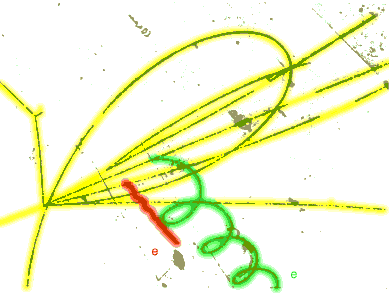
The tracks highlighted in the photograph on the right were made by subatomic particles in a collider. The tracks highlighted in red and green were made by electrons.
How are the tracks made by the electrons different from the other tracks? Why are they different?
How is the track highlighted in red different from the track highlighted in green? Why is it different?
A positively charged particle is placed at rest in a region of uniform electric and magnetic fields. Describe…
the direction of the electric and magnetic forces just before the particle starts moving
the resulting path of the charge
if the two fields are…
parallel
antiparallel
perpendicular
algebraic
Three problems about electromagnetic units…
Show that the units in this expression (μ0 = 4π × 10−7 T m/A) are equivalent to the units in this expression (μ0 = 4π × 10−7 N/A2) for the permeability of free space.
Express the permeability of free space in terms of SI base units.
Reduce the tesla to its equivalent in SI base units.