Weight

Practice
practice problem 1
 |
 |
 |
 |
 |
 |
 |
solution
Use the weight formula.
W = mg
Solve for mass. Substitute one newton for weight and one standard earth gravity for gravity.
| m = | W | = | 1 N | |
| g | 9.8 m/s2 | |||
| m = | 0.102 kg = 102 g | |||
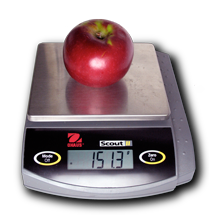
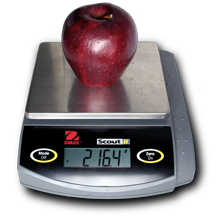
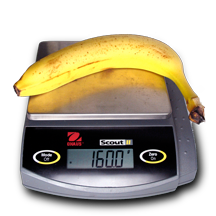
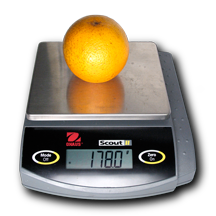
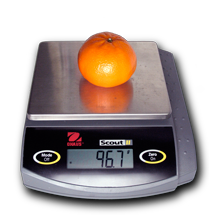
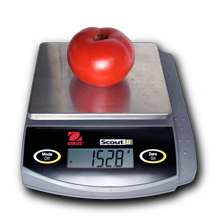
The 96.7 gram tangerine comes closest to this value. Not all tangerines weigh 98.7 grams, however, so this is only a rule of thumb. There are certainly apples, bananas, oranges, tomatoes, and other fruits out there with a mass of approximately 102 grams and thus a weight of approximately one newton.
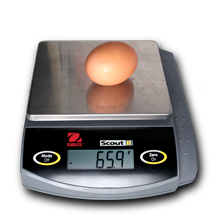
Those of you familiar with multiple choice tests should have eliminated the chicken egg as a possible answer. A chicken egg is only metaphorically the "fruit of the chicken".
practice problem 2
solution
Here's the way I usually do it — using values I've memorized from years of use.
| W = | mg |
| 2.2 lb = | (1 kg)(9.8 m/s2) |
| 1 lb = | 4.45… N |
| 1 N = | 0.224… lb |
Here's a more accurate way to do it — using values that are exact by definition.
| W = | mg |
| 1 lb = | (0.45359237 kg)(9.80665 m/s2) |
| 1 lb = | 4.448221615… N |
| 1 N = | 0.224808943… lb |
Not quite a quarter pound, but you get the idea.
| 0.20 lb | < | 0.224808943… lb | < | 0.25 lb |
| ⅕ lb | < | 1 N | < | ¼ lb |
The fraction 940 gives a decimal expansion of 0.225, which is accurate to three significant figures. Not my favorite fraction, but it gets the job done. With sixteen avoirdupois ounces in a pound, one newton is also about 3½ ounces.
| 1 N ≈ | 9 lb | × | 16 oz | = | 18 oz | = 3½ oz |
| 40 | 1 lb | 5 |
practice problem 3
solution
Answer it.
practice problem 4
solution
Answer it.